
Every VAT season I get at least one call that starts the same way: "Sir, I think I put the wrong figure." Sometimes it is a zero missing from the sales. Sometimes the purchase of a whole month went into the wrong box, or exempt sales were typed as taxable. The return is already submitted, the submission number is already generated, and the person on the other end of the phone is hoping there is an "edit" button somewhere.
Until this year, there wasn't. Once a VAT return went in, it stayed in. Now, for the first time, the VAT Act gives us a proper way back. A return that was filed on time can be amended within seven days of filing. It sounds like a small procedural change. For those of us who file returns month after month, it is one of the most practical things the Finance Act 2083 has done.
Table of Contents
- Watch first: the step-by-step video
- How we fixed mistakes before (and why it was messy)
- What the law now says
- What you need before you start
- The steps on the IRD portal
- A worked example: Rs 1,80,000 of missing sales
- Use the seven days wisely
- Why this matters more than it looks
- What I would like to see next
- Sources
Watch first: the step-by-step video
We recorded the whole correction on the IRD taxpayer portal, screen by screen, in Nepali. If you only want the clicks, start here and come back for the "why".
Video: VAT Return कसरी सच्याउने? IRD Portal मा Step-by-Step (नेपाली) on our U4C YouTube channel.
How we fixed mistakes before (and why it was messy)
Before this amendment, the VAT Act simply had no provision for correcting a return once it was submitted. So when a client came to us with a wrong figure, we had two practical choices, and neither was clean.
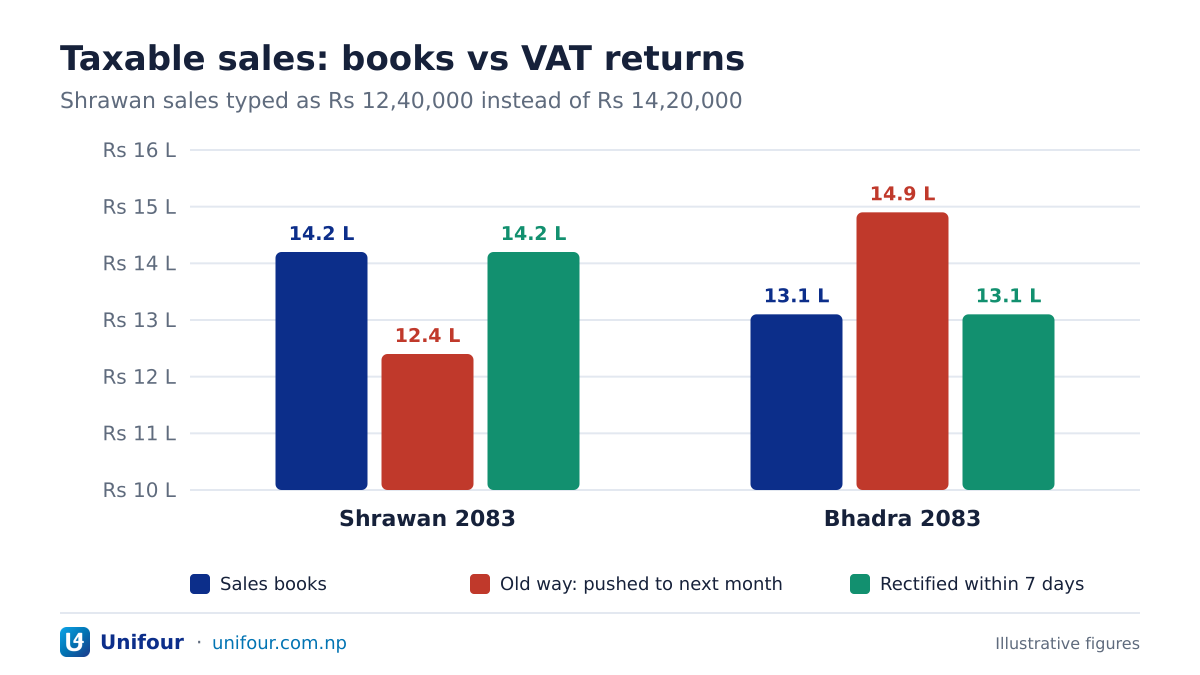
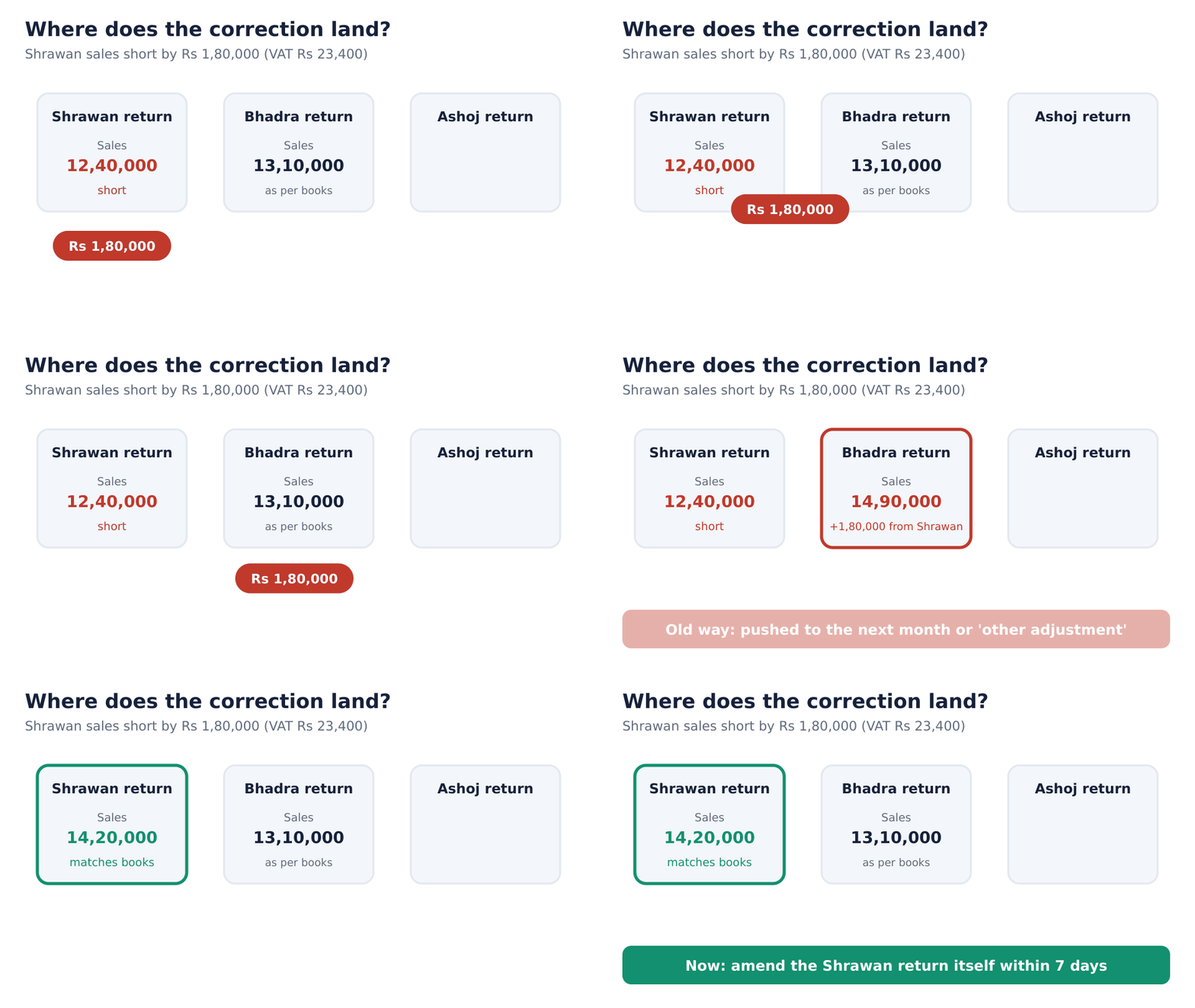
- Push it into the next month. If Shrawan sales were understated by Rs 1,80,000, we added that Rs 1,80,000 to Bhadra's sales. The tax got paid eventually, but now both months were wrong: Shrawan too low, Bhadra too high.
- Use the "अन्य थप / घट" (other additions / deductions) line in a later return to adjust the tax. This settled the tax figure but left the sales, purchase and taxable / exempt split of the original month untouched.
Either way, the books said one thing and the VAT returns said another. Then came the audit. The auditor reconciles VAT returns with the sales register month by month, finds differences in two months instead of none, and asks for an explanation. The same story had to be told again at the time of income tax assessment, sometimes years later, by someone who no longer remembered why Bhadra looked so high.
What the law now says
The Finance Act 2083 added a new sub-section (4) to section 18 of the VAT Act, 2052. As the ICAN budget highlights record it, a VAT return submitted within the deadline may be amended, if required, within 7 days from the date the return was submitted, following the procedure the Department prescribes. The comparison column for the old law reads simply "no provision". PKF TR Upadhya's summary puts it the same way: taxpayers who file on time can correct errors by submitting an amended return within 7 days of the original filing.
Three conditions are worth underlining:
- The return must have been filed on time. A late return can't be corrected this way.
- The clock starts on the day you filed, not on the due date.
- It is done through the Department's procedure, which in practice means the amendment option on the taxpayer portal shown in the video, not a letter to the tax office.
What you need before you start
- Taxpayer portal login for the PAN (username and password), the same one used to file the return.
- The submission number of the return you want to correct, and a copy of the return as filed.
- The corrected figures, worked out from the sales and purchase registers: taxable sales, exempt sales, exports, taxable purchases and imports, and any credit or debit notes. Don't correct "roughly". Recompute the whole month.
- Funds for any extra tax. If the correction increases the VAT payable, that difference has to be deposited, normally through a payment voucher on the IRD e-payment site.
- A short note for your file: what was wrong, what changed, the old and new submission details. Your auditor will thank you.
The steps on the IRD portal
The video shows each screen. In outline:
- Log in to the IRD taxpayer portal with the PAN's login.
- Go to the VAT return section and open the return already submitted for the period, using its submission number.
- Choose the option to amend (सच्याउने) that return. It is only offered while the return is inside the 7-day window.
- Change the figures that were wrong (sales, purchases, taxable or exempt amounts) and let the portal recompute the tax.
- Check the new payable or credit carefully, then submit and save the new acknowledgement.
- If more tax is now payable, create the payment voucher for the difference and pay it, ideally before the due date.
A worked example: Rs 1,80,000 of missing sales
A trading company files its Shrawan 2083 return on Bhadra 18. Two days later, while reconciling, the accountant notices that Shrawan's taxable sales were entered as Rs 12,40,000. The sales register says Rs 14,20,000. One invoice batch was missed.
| Shrawan 2083 | As filed | Correct | Difference |
|---|---|---|---|
| Taxable sales | Rs 12,40,000 | Rs 14,20,000 | Rs 1,80,000 |
| Output VAT (13%) | Rs 1,61,200 | Rs 1,84,600 | Rs 23,400 |
| Input VAT on purchases | Rs 1,17,000 | Rs 1,17,000 | - |
| VAT payable | Rs 44,200 | Rs 67,600 | Rs 23,400 |
The old way: Rs 1,80,000 is added to Bhadra's sales, or Rs 23,400 goes through "अन्य थप". Shrawan stays understated and Bhadra overstated, and both show up as differences when the auditor reconciles the year.
The new way: the Shrawan return is amended on or before Bhadra 25 (seven days from Bhadra 18), the extra Rs 23,400 is paid by the due date, and Bhadra is filed with Bhadra's own figures.
Use the seven days wisely
The window runs from the filing date. That has a practical consequence. If you file on the last day, the 25th, most of your seven days fall after the due date for payment. If the correction increases the tax, the extra amount is paid late, and as we read the law, the normal late-payment interest would run on it for those days. File three to seven days early and the whole window sits before the deadline.
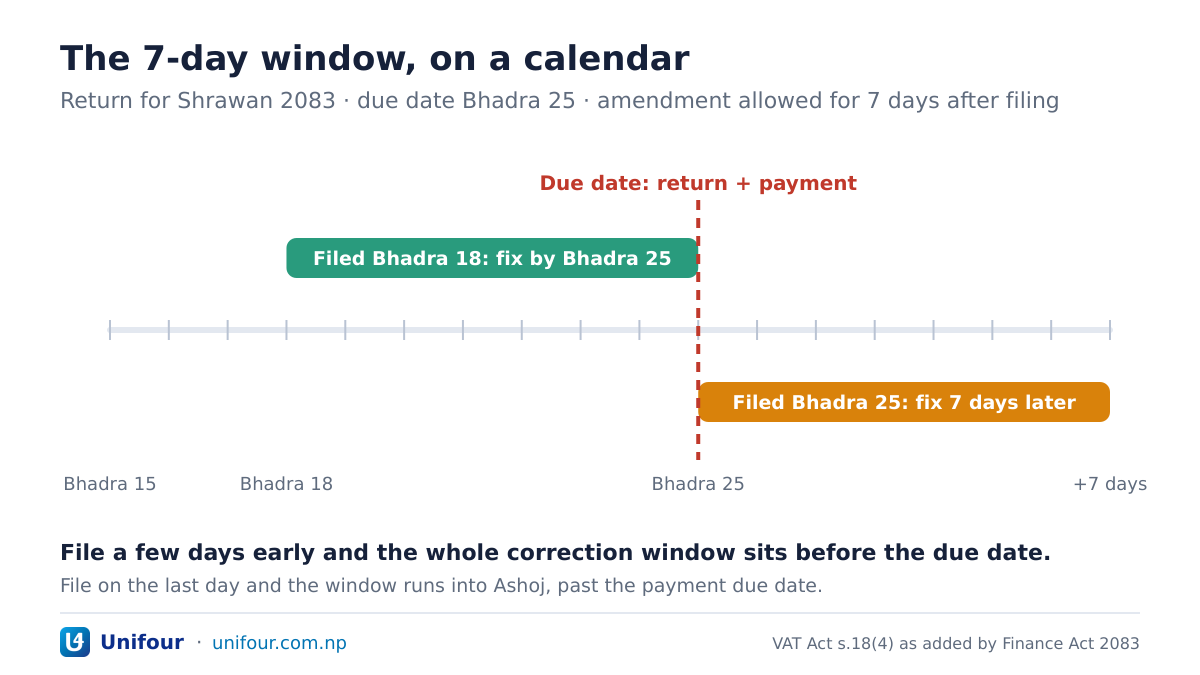
My own routine now: file by the 18th or 20th, reconcile the return against the registers the next morning, and only then close the month.
Why this matters more than it looks
- The correction lands in the right month. Sales, purchases and the taxable / exempt split stay true for each period, which is exactly what the VAT return is supposed to show.
- Audits get simpler. No more month-to-month differences that need a story. The VAT returns reconcile with the books as they should.
- No visit to the tax office. It is done online, by the taxpayer, without a letter or an officer's discretion.
- It allows for real life. Returns get filed in a rush on the 24th. A supplier's invoice arrives a day late. A credit note gets missed. Information turns up after filing. Now there is a short, lawful way to fix that.
On the income tax side we have long been able to correct a filed return within roughly a month on the portal. Section 18(4) finally gives VAT a similar safety valve, shorter but just as useful.
What I would like to see next
This is a good change, and I want to say so plainly, because we are usually quicker to complain than to appreciate. A taxpayer who makes an honest mistake and wants to fix it should be able to do so without fear and without a trip to the tax office.
Seven days is a start. I would like the IRD to go further in the same spirit. A longer window for corrections that increase tax, perhaps up to the next month's due date, would bring in more correct tax, not less. Amended returns could show the original and revised figures side by side on the portal, so that auditors and officers see the full history. And the same correct-it-yourself approach would help in TDS returns and annex corrections, where a wrong PAN or amount still means paperwork. Small, user-friendly changes like this one make compliance easier for everyone: taxpayers, accountants and the department itself.
Related guides: VAT compliance in Nepal, the VAT Act in English, Finance Act 2083: the tax waiver and our late VAT payment calculator.
Sources
- ICAN: Highlights of Federal Budget of Nepal 2083/84 (amendments in the Value Added Tax Act, 2052: section 18(4))
- PKF TR Upadhya & Co.: Nepal Budget Statement Highlights 2026-27
- Value Added Tax Act, 2052, section 19: payment of tax
- Inland Revenue Department (taxpayer portal and notices)
- U4C: VAT Return कसरी सच्याउने? IRD Portal मा Step-by-Step
Written from practice, with the law as we read it in Kartik 2083. Check the Department's current procedure before you rely on it for a particular return.