
Every year, a surprising number of businesses in Nepal pay Rs 5,000 or more in extra tax for a form they never knew they had to file. It does not appear as tax on any invoice, it is not interest on a late payment, and it is often only noticed when the accountant prepares the annual return or the tax clearance certificate. The charge is the fee under Section 117(1)(a) of the Income Tax Act, 2058 for not submitting the estimated income return under Section 95(1).
The good news is that this fee is almost entirely avoidable. The estimated return takes about ten minutes once your figures are ready, and it can be filed together with your first installment. This guide explains what the estimated return is, why the fee is charged even when you have paid your installment tax, how big the fee can really get, and the few simple steps that stop it.
Table of Contents
- What the estimated income return is
- Who has to file it
- Why the Rs 5,000 fee is charged, and why it can be more
- The separate cost: 15% interest on short installments
- How to avoid it in five simple steps
- Common mistakes we see in practice
- Frequently asked questions
- Sources
What the estimated income return is
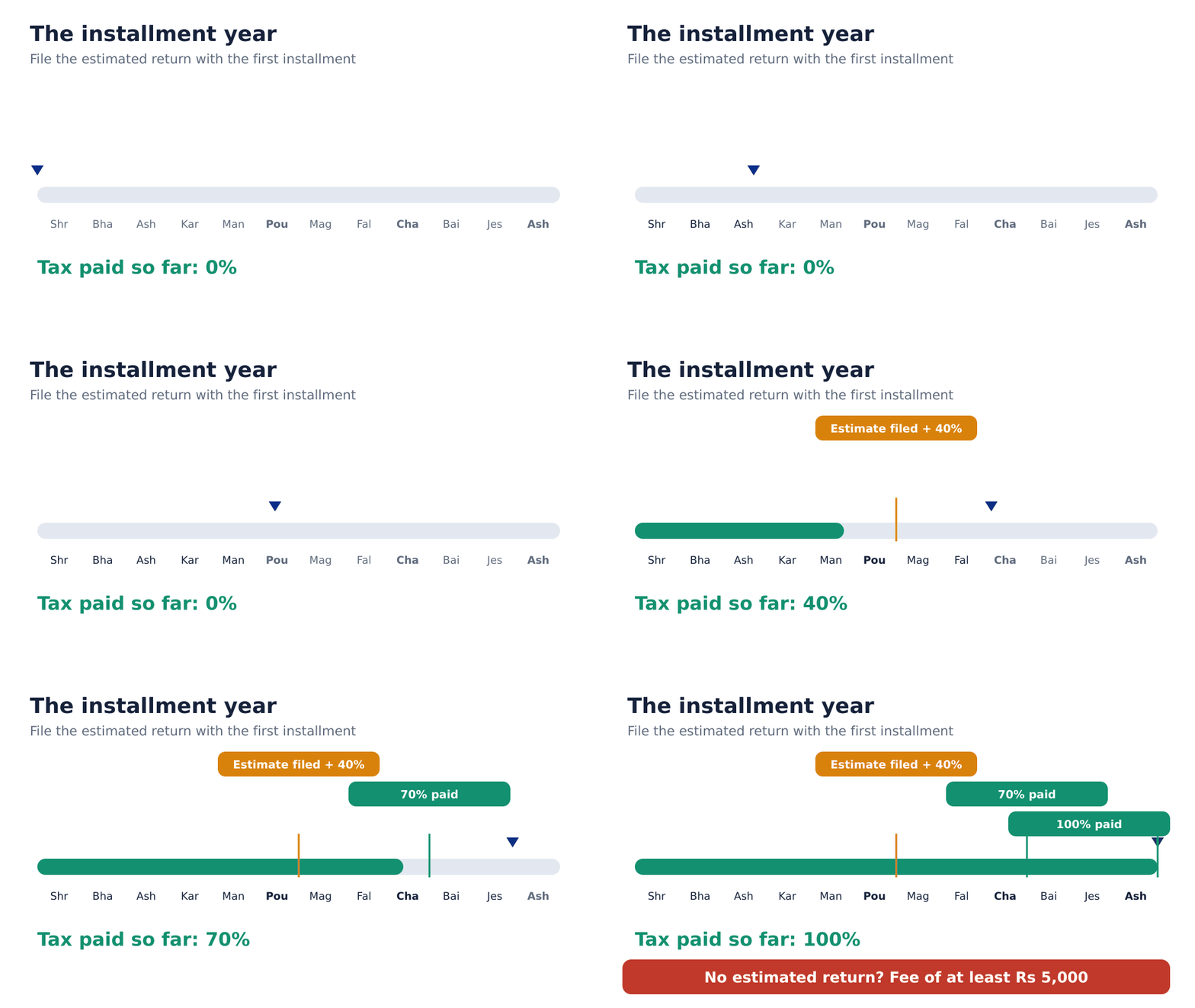
Nepal collects income tax from businesses in three steps during the year rather than in one lump sum after it ends. Section 94 of the Income Tax Act requires a person with income from a business or investment to pay tax in installments, based on what they expect to earn in the current income year. Section 95 then requires that person to tell the Inland Revenue Department (IRD) what that expectation is, through a short statement called the estimated income return (sometimes called the estimate return or installment return).
The installment schedule most businesses follow is:
| Installment | Due by | Cumulative tax to be paid |
|---|---|---|
| First | End of Poush (around mid-January) | 40% of the estimated tax for the year |
| Second | End of Chaitra (around mid-April) | 70% |
| Third | End of Ashadh (around mid-July) | 100% |
The estimated return goes in with the first installment, by the end of Poush. For FY 2083/84 that means by the end of Poush 2083, which falls in mid-January 2027. The return is a forecast: it states the income you expect for the year and the tax on it, net of the tax already deducted at source (TDS) on your income.
Who has to file it
The duty follows the duty to pay installment tax. In practice that means:
- Companies, partnership firms and sole proprietorships that earn business income;
- Individuals with investment income such as rent, where the tax is not fully covered by TDS;
- Any of the above where the tax expected for the year, after the TDS credit, is not trivial. Practitioners commonly treat Rs 5,000 of net estimated tax as the point at which installments are required; check your own position against the current Act if you are near that line.
People who only earn a salary normally do not file an estimated return, because the employer deducts tax every month. Taxpayers under the presumptive scheme of Section 4(4) follow their own simpler rules.
A business that expects a loss for the year has no installment to pay, but a lot of accountants still file a nil estimate so that there is a record on the IRD system showing the business considered the question. It costs nothing and removes any argument later.
Why the Rs 5,000 fee is charged, and why it can be more
Section 117(1)(a) charges a fee to a person who does not submit the income return required by Section 95(1). The fee is:
Two points catch people out:
- It is a fee for the missing form, not for missing tax. You can pay all three installments in full and on time and still be charged, because the law punishes the absence of the statement itself. Interest on unpaid tax is a different charge under a different section.
- Rs 5,000 is the floor, not the ceiling. Once assessable income passes Rs 50 lakh, 0.10% of it is more than Rs 5,000, and the fee grows with income.
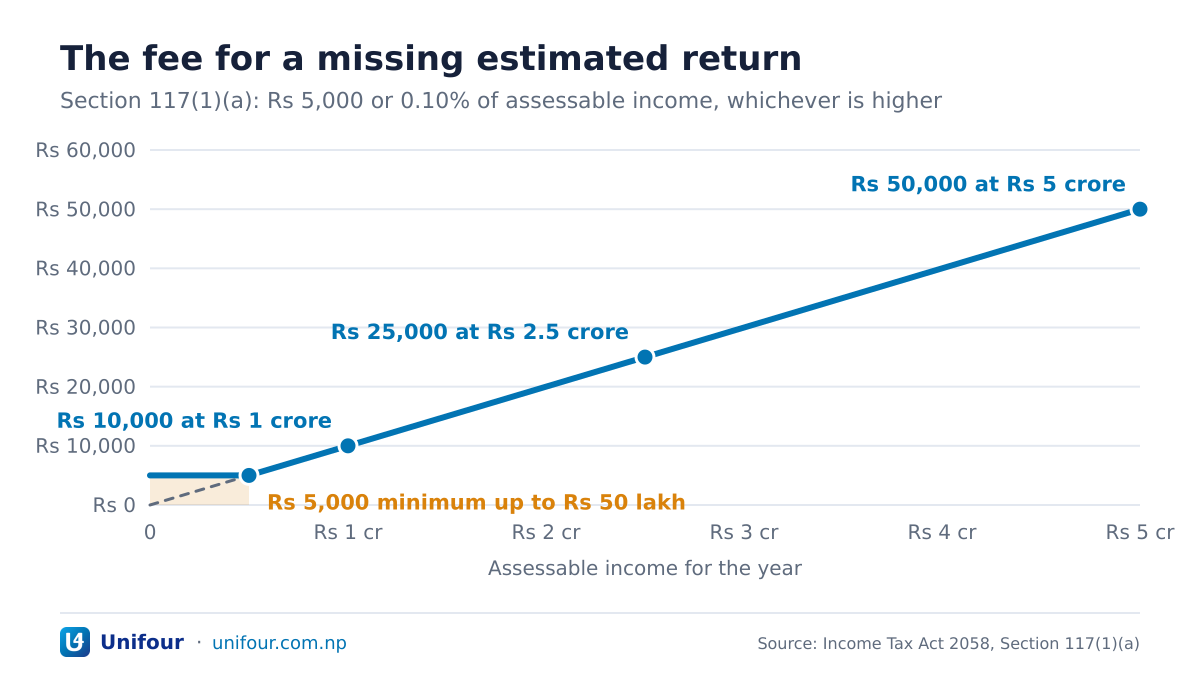
| Assessable income for the year | 0.10% of income | Fee charged |
|---|---|---|
| Rs 20 lakh | Rs 2,000 | Rs 5,000 |
| Rs 50 lakh | Rs 5,000 | Rs 5,000 |
| Rs 1 crore | Rs 10,000 | Rs 10,000 |
| Rs 2.5 crore | Rs 25,000 | Rs 25,000 |
| Rs 5 crore | Rs 50,000 | Rs 50,000 |
Because the fee is not deductible as a business expense, it comes straight out of after-tax profit. For a small company with thin margins, Rs 5,000 to Rs 25,000 every year for a ten-minute form is a poor trade.
The separate cost: 15% interest on short installments
The fee is only half of the risk. Section 118 charges interest, commonly applied at 15% a year, when the installments you paid are less than what you should have paid by each date. It is worked out for each installment period on the shortfall. A business that forgets the estimated return usually forgets the installments too, and then pays both.
Example: a company whose final tax for the year turns out to be Rs 6,00,000, which paid nothing until it filed the annual return in Poush of the next year, faces the Section 117 fee plus Section 118 interest on Rs 2,40,000 from Poush, on a further Rs 1,80,000 from Chaitra and on Rs 1,80,000 from Ashadh, and then Section 119 interest on any balance still unpaid after the year. A single reminder in Poush would have prevented all of it.
If you are behind on VAT as well as income tax, our free late VAT payment calculator shows the interest and penalty for any number of days late, so you can see what waiting is really costing.
How to avoid it in five simple steps
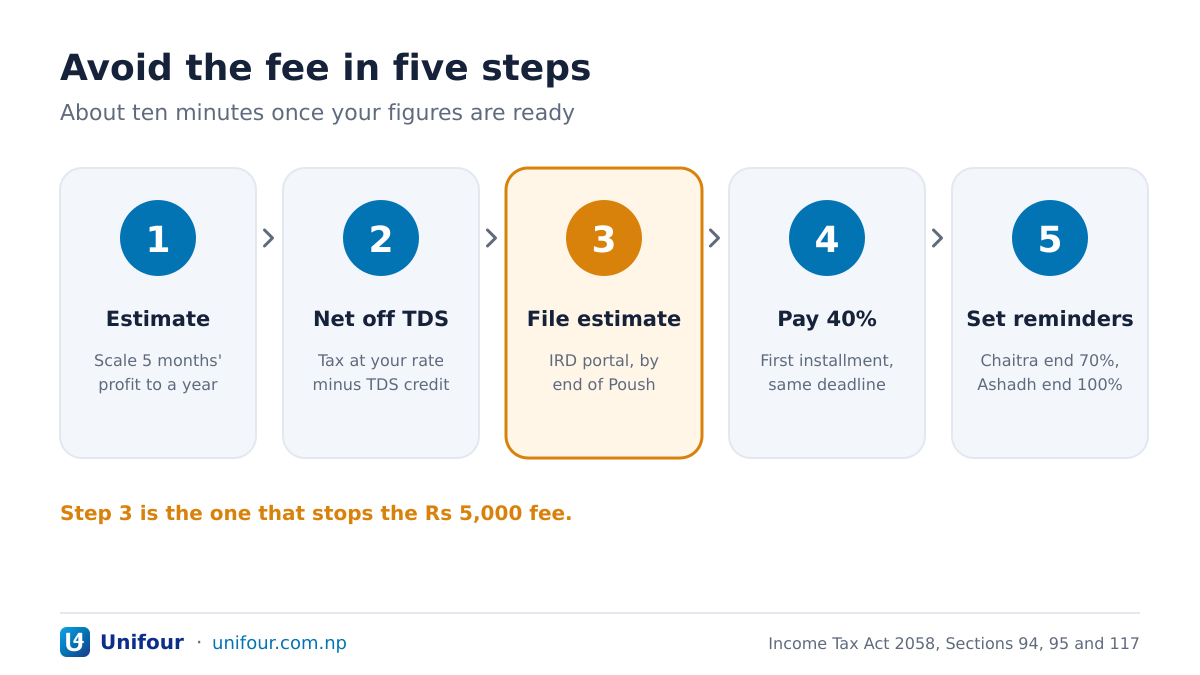
- Estimate the year's profit in Mangsir or early Poush. Take the actual profit for the first five months (Shrawan to Mangsir), scale it to twelve months, and adjust for anything you know is coming: a big contract in Falgun, seasonal sales during Dashain and Tihar, a new loan. The estimate does not have to be perfect; it has to be honest and reasonable.
- Work out the tax and deduct the TDS already credited to you. Apply your normal rate (25% for most companies, different for special industries and individuals) and subtract the TDS that customers and banks have deducted on your income. You can see that TDS against your PAN on the IRD taxpayer portal.
- File the estimated income return on the IRD taxpayer portal before the end of Poush. Log in with your PAN, open the income tax section, choose the estimated return for the current income year, enter the estimated income and tax, and submit. Save the submission number and a PDF of the acknowledgement.
- Pay the first installment of 40% through the IRD e-payment voucher or your bank by the same date. Keep the voucher number; you will need it in Annex 10 of the annual return.
- Put Chaitra end and Ashadh end in your calendar now. If your business changes during the year, Section 95 allows a revised estimate, and the later installments follow the revised figure.
Common mistakes we see in practice
- "We paid the installment, so we are fine." The fee is for the form, not the payment. Payment without the return still attracts the Section 117 fee.
- Filing the estimate after Poush. A late estimate is better than none, but do not assume it removes the fee for the period it was late. File it on time.
- Ignoring TDS when estimating. Businesses with large TDS (contractors, consultants, interest earners) often overpay installments. Deduct the TDS that will be credited to you, so cash is not locked up with the IRD.
- Leaving it to the auditor. Your auditor usually arrives months after Poush. The estimated return is a management task during the year, not an audit task after it.
- Not keeping the submission number. When the annual D-03 is prepared, the installment vouchers and the estimate are matched. Missing paperwork means hours of searching later.
Frequently asked questions
Is the Rs 5,000 a tax or a penalty?
It is a fee under Section 117 of the Income Tax Act. It is not a credit against your tax and you cannot claim it as an expense.
We expect a loss this year. Do we still file?
If there is no installment tax to pay, the duty to file is weak. Many practitioners still file a nil estimate as a record. It takes minutes and avoids any later dispute.
Our profit turned out much higher than our estimate. Is that a problem?
The return is an estimate, so a difference by itself is not an offence. However, if your installments fell short of what a reasonable estimate would have produced, interest under Section 118 can apply. Revise the estimate during the year when you see the change coming.
Can the fee be waived?
Fees and interest are sometimes waived under a Finance Act scheme, such as the Finance Act 2083 waiver, but you cannot plan on it, and it will not save you the time spent applying. Filing on time is cheaper.
Sources
- Income Tax Act, 2058 (2002), Section 94 (installment tax), Section 95 (estimated income return), Section 117 (fees) and Section 118 (interest on short installments). English text: nepallaws.com, Section 117; full Act on our Income Tax Act page.
- NBSM & Associates, 5 Nepal tax facts entrepreneurs should know (installment percentages, Rs 5,000 threshold, 15% interest).
- Inland Revenue Department, ird.gov.np (taxpayer portal and notices).
This guide reflects the Income Tax Act as we read it in Kartik 2083. Rates and thresholds can change with each Finance Act; confirm the current figures before filing.