
Every Nepali budget speech is followed by the same question from clients who are behind on their taxes: "Is there a waiver this year?" For several years running, the answer has been yes. The Finance Act for FY 2083/84 lets taxpayers clear old VAT, income tax and excise dues by paying the principal tax plus just 1%, with the interest, fees and penalties waived. For anyone who is behind, that is genuinely good news.
But step back and look at the pattern, and it raises an uncomfortable question for the businesses that do pay on time. If a waiver arrives almost every year, and each one is cheaper than the last, is paying on time actually the smart financial choice? This article looks at what the yearly waivers have offered, what they do to a taxpayer's incentives, and a better design that would bring in more revenue with less drama.
Table of Contents
- This year's offer: principal plus 1%
- A waiver almost every year
- The arithmetic every finance manager now does
- Who pays for it
- A better design: lower, permanent, predictable charges
- What to do now
- Sources
This year's offer: principal plus 1%
Under the Finance Act 2083, taxpayers with old VAT, income tax or excise dues can file the missing returns, pay the tax and add 1%, and the interest, additional fees and penalties for those periods are waived. Most provisions run to the end of Poush 2083 (mid-January 2027). We cover who qualifies and the exact filing steps in our guide to the Finance Act 2083 tax waiver.
The settlement also needs a written application to the tax office. If you are using the scheme, Document Studio has ready Nepali application formats for the income tax waiver under Section 40(3) and for VAT return relief: fill in the periods and amounts, and download a Word file to sign.
A waiver almost every year
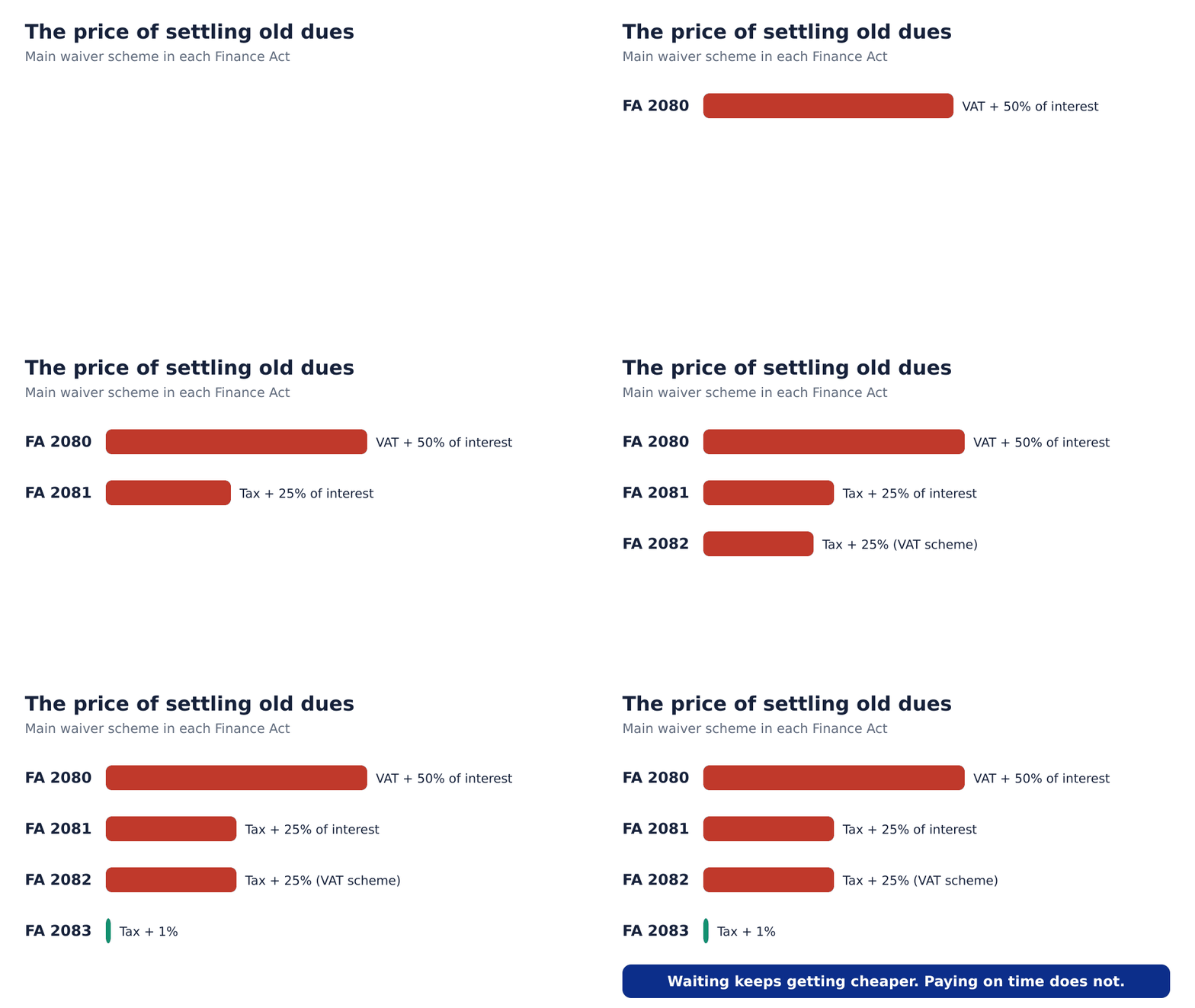
The 2083 scheme is not a one-off. Recent Finance Acts have each carried some form of settlement for old dues, under different headings and for different groups:
| Finance Act | Who it covered (main scheme) | What you had to pay | Deadline |
|---|---|---|---|
| 2080 (FY 2080/81) | VAT-registered taxpayers who had not filed returns up to Ashadh 2080 | VAT per return + 50% of the interest; fees and penalties waived | Within the notified period |
| 2081 (FY 2081/82) | Income tax non-filers, all earlier years | Tax + 25% of the interest; remaining interest and penalties waived | End of Falgun 2081 |
| 2082 (FY 2082/83) | VAT returns or tax outstanding up to Chaitra 2081 | Tax + 25% (of tax and interest, as summarised in the source); rest waived | End of Poush 2082 |
| 2083 (FY 2083/84) | VAT, income tax, excise, disputes and more | Tax + 1%; interest, fees and penalties waived | End of Poush 2083 (most provisions) |
Summarised from IRD notices and published summaries listed under Sources. Each scheme had further categories and conditions; this table shows the main one for the comparison.
The direction is clear. Five years ago a late payer had to give up a meaningful share of the interest. This year the cost of settling is one percent.
The arithmetic every finance manager now does
Take a business with Rs 10 lakh of VAT due. Under the VAT Act, late VAT carries interest of 15% a year and a penalty of 10% a year (our late VAT payment calculator does this sum for any dates). Three years of delay under the normal rules would cost Rs 7.5 lakh on top of the tax. That is a strong reason to pay on time.
Now assume the business expects a waiver like this year's. It keeps the Rs 10 lakh in working capital, where it earns, say, 12% a year in the business or saves a 12% bank loan:
| Choice | Paid to IRD | Value of keeping the cash for 3 years | Net position |
|---|---|---|---|
| Pay on time | Rs 10,00,000 | Nil | Baseline |
| Wait 3 years, normal law applies | Rs 17,50,000 | + Rs 4,04,928 | Rs 3,45,072 worse |
| Wait 3 years, settle at tax + 1% | Rs 10,10,000 | + Rs 4,04,928 | Rs 3,94,928 better |
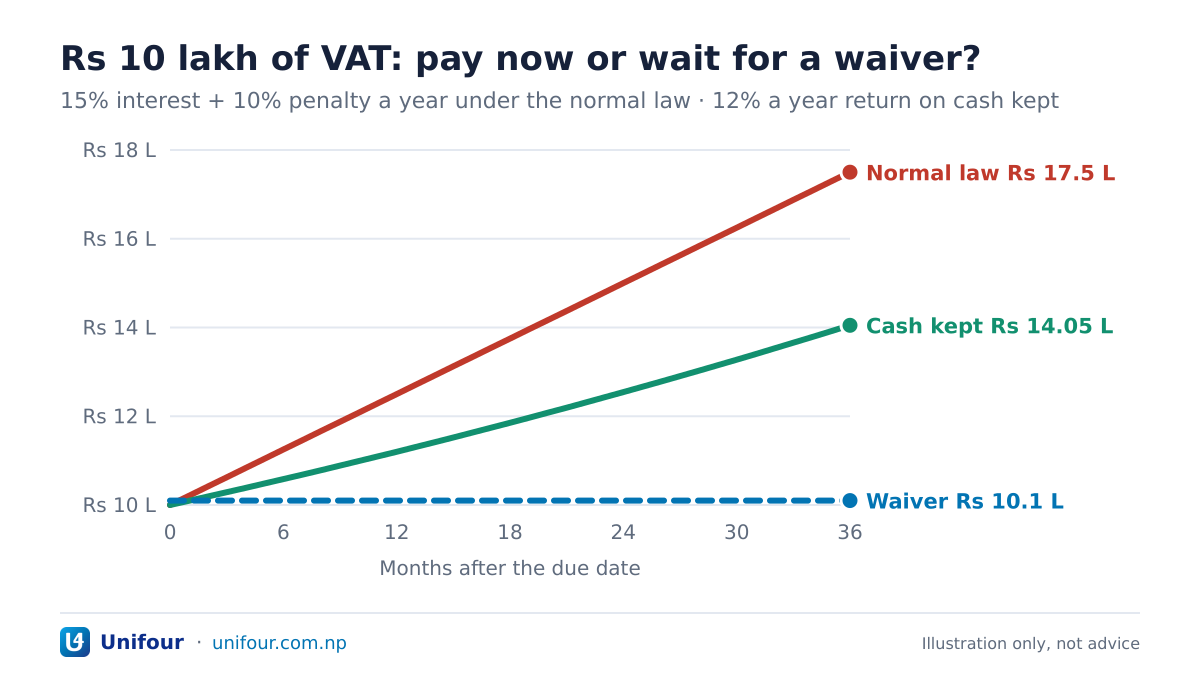
The penalty only works if people believe it will be charged. Once a waiver is expected, the rational choice for a business short of cash becomes: wait, invest, and settle in the cheapest year. We hear this reasoning from honest, compliant clients who have paid on time for years and are now asking whether they have been foolish to do so. That is the real cost of a yearly amnesty.
Who pays for it
- The taxpayer who paid on time. A competitor who delayed effectively received an interest-free loan from the state and can underprice the one who paid.
- The treasury. Money that arrives three years late is worth less, and it arrives in lumps that make budgeting harder. The IRD reported about Rs 275 billion of tax arrears owed by over 30,000 taxpayers as of FY 2081/82, with income tax arrears making up about Rs 219 billion.
- Compliance culture. Every waiver teaches a new group of taxpayers that deadlines are negotiable, and next year's arrears grow.
Waivers do have a purpose. They clear unrecoverable old cases, bring informal businesses into the system and save the IRD time on disputes. The problem is not one waiver, it is a waiver every year, announced in advance often enough that people plan around it.
A better design: lower, permanent, predictable charges
The reason taxpayers wait for amnesties is that the normal late charges are heavy. At 25% a year for VAT, a business that slips for a few months quickly owes so much in interest and penalty that it is easier to stop paying and wait. Instead of making the charges painful and then forgiving them, make them fair and certain:
- A small, flat late charge for short delays, for example 5% of the tax for anything paid within six months of the due date, with no separate penalty layer.
- Interest after that at a market rate, close to what a bank would charge a business, so delay is never cheaper than borrowing.
- No recurring amnesties. A standing voluntary disclosure route for people who come forward on their own, at a modest fixed cost, replaces the yearly schemes.
- A visible reward for paying on time: faster refunds, priority tax clearance or a lighter audit selection risk for clean records.
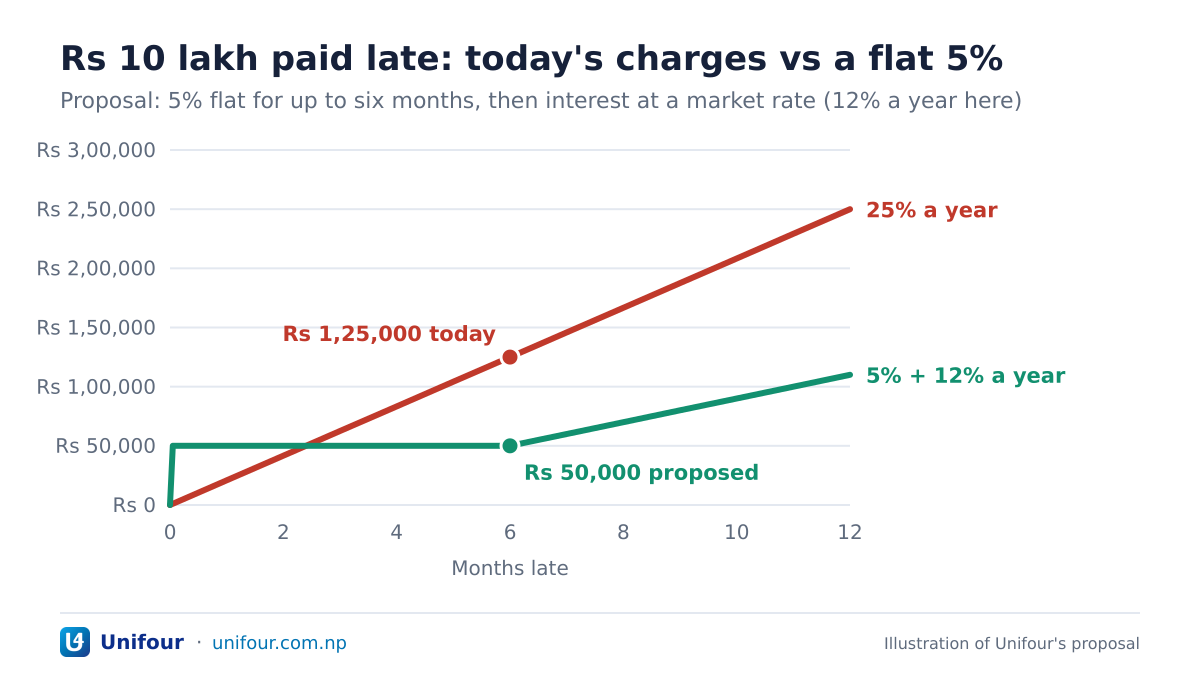
Under this design, a business that misses a deadline by a few months pays Rs 50,000 on Rs 10 lakh and moves on, instead of facing Rs 1.25 lakh and a reason to wait for next year's waiver. Collections come earlier, honest taxpayers stop feeling penalised for their honesty, and the IRD spends less time on settlement paperwork.
What to do now
- If you have old dues, use the current scheme before the end of Poush 2083. Read the Finance Act 2083 guide and prepare the application in Document Studio.
- If you are up to date, stay that way. A waiver might come next year, or it might not, and it might exclude your case.
- Keep the dates in front of you. The Unifour portal keeps each company's VAT, TDS and income tax deadlines, filed returns and payment vouchers in one place, so a slip is noticed in days, not years.
Sources
- Finance Act 2083 provisions: our guide, Finance Act 2083 tax waiver.
- Finance Act 2080 VAT scheme: Inland Revenue Department notice, ird.gov.np (PDF, Nepali).
- Finance Act 2081 income tax scheme: Tax concessions and relief measures under Budget 2081/82.
- Finance Act 2082 VAT scheme (Section 25): Bizsewa, Special tax/VAT exemptions under the Finance Bill 2082.
- Finance Bill 2083/84 summary: Bizsewa, Clear tax and company compliance penalties under Budget 2083/84.
- Tax arrears: The Himalayan Times, Govt yet to recover Rs 275 billion in tax arrears: IRD (18 Nov 2025).
- VAT interest and penalty rates used in the example: Value Added Tax Act, 2052 (see our VAT Act page and calculator).
The example assumes a 12% return on cash and ignores tax effects; your figures will differ. The views on policy are Unifour's own.