The Finance Act 2083 (the tax law that accompanies the Budget for FY 2083/84, 2026/27) has opened one of the most generous settlement windows Nepal has offered in years. If you have old, unpaid or unfiled VAT, income tax or excise dues, you can now clear them by paying only the principal tax plus a flat 1%. In return, the Inland Revenue Department (IRD) waives the interest, additional fees, late-filing fees and penalties that would normally make an old liability several times larger than the tax itself.
In short: the Finance Act 2083 provides a rebate for coming forward and filing. The cost of regularising your records is just a 1% add-on to the actual tax — which is why so many businesses are using this window to finally close out legacy dues before the deadline. This guide explains who qualifies, what is waived, and the exact step-by-step process to claim it.
Table of Contents
- What the Finance Act 2083 waiver scheme is
- The "principal + 1%" principle
- VAT rebate — who qualifies
- Income tax rebate — who qualifies
- Excise rebate
- Pending disputes & annual Finance Act dues
- The step-by-step process to claim the rebate
- Deadlines at a glance
- What exactly gets waived
- How Unifour can help
What the Finance Act 2083 waiver scheme is
Every year the Finance Act carries, alongside the rates and slabs, a set of one-time concession and settlement provisions. For FY 2083/84 these are unusually broad. They cover taxpayers who:
- collected or should have collected VAT or excise but never filed or paid it;
- filed returns but left the tax balance outstanding;
- were assessed by the IRD but have not paid the assessed amount;
- never obtained a PAN despite having taxable income;
- have cases pending before the IRD administrative review, the Revenue Tribunal or the courts.
For almost all of these, the formula is the same: file the outstanding return, pay the tax, add 1%, and the penalties, interest and fees drop away.
The "principal + 1%" principle
This is the heart of the scheme and the part most people misunderstand, so it is worth stating plainly:
You pay: the actual tax liability + 1% of that liability.
You do NOT pay: interest, additional fees, late-filing fees or penalties for the period covered.
The 1% is not a new tax or a penalty in disguise — it is the nominal price of using the amnesty. On a liability of NPR 100,000, you pay NPR 101,000 and the (often much larger) interest and penalty are written off. A few categories (for example non-PAN holders who come forward under Sec. 40(1)) pay just the tax with fees and interest waived and no 1% add-on at all; your advisor will confirm which bucket you fall in.
VAT rebate — who qualifies
There are three common VAT situations, each with its own provision:
| Situation | What you do | Pay |
|---|---|---|
| Made taxable sales but never collected / filed VAT (Sec. 41) | File the VAT returns up to Chaitra 2082 | Tax + 1% |
| Returns filed, balance still outstanding as of Jestha 15, 2083 (Sec. 44) | Clear the outstanding balance | Balance + 1% |
| Already assessed by IRD but unpaid (Sec. 45) | Pay the assessed amount | Assessed amount + 1% |
In every case the interest, additional fees, penalties and late fees are waived once you pay by the deadline. Telecommunication service providers are excluded from Sec. 45. Several specific sectors (gold & silver ornaments, milk-based paneer, insurance agents, and old sales/hotel/entertainment/contract taxes) get automatic waivers that need no action — ask us if that applies to you.
Income tax rebate — who qualifies
| Situation | What you do | Pay |
|---|---|---|
| Have taxable income but no PAN (Sec. 40(1)) | Obtain a PAN and file FY 2079/80 to 2082/83 | Tax only (fees & interest waived) |
| Active PAN with outstanding dues (Sec. 40(3)) | File the return and clear the dues | Tax + 1% |
| Inactive / dormant PAN (Sec. 40(2)) | File FY 2082/83 to deregister or reactivate | Tax due |
Returns for years earlier than FY 2079/80 generally need not be filed. Separate provisions cover companies regularising under the Companies Act, associations/NGOs, community schools and health institutions, and staff of UN / international bodies / diplomatic missions — each with its own deadline.
Excise rebate
Traders in excisable goods who did not collect excise can file the return and pay the excise + 1%, and the late fees and penalties are waived (Sec. 43(1)). Licensees who failed to renew can pay the FY 2082/83 renewal fee, with the renewal fees and penalties for the remaining years waived (Sec. 43(2)). Arrears under the old Excise Duty Act are waived automatically.
Pending disputes & annual Finance Act dues
- Pending tax disputes (Sec. 46): If you have an income tax, VAT or excise case under IRD administrative review, at the Revenue Tribunal or before a court, you may withdraw the case and pay the disputed amount + 1%, with penalties, interest and fees waived. Telecom providers excluded.
- Revenue Leakage Act cases (Sec. 50): Pending income tax and VAT cases in court may be settled by depositing the assessed claim + 1% and applying within the window.
- Annual Finance Act dues (Sec. 49): Those who underpaid or did not file under earlier annual Finance Acts may pay the outstanding amount + 1% with the return, and penalties, interest and fees are waived.
The step-by-step process to claim the rebate
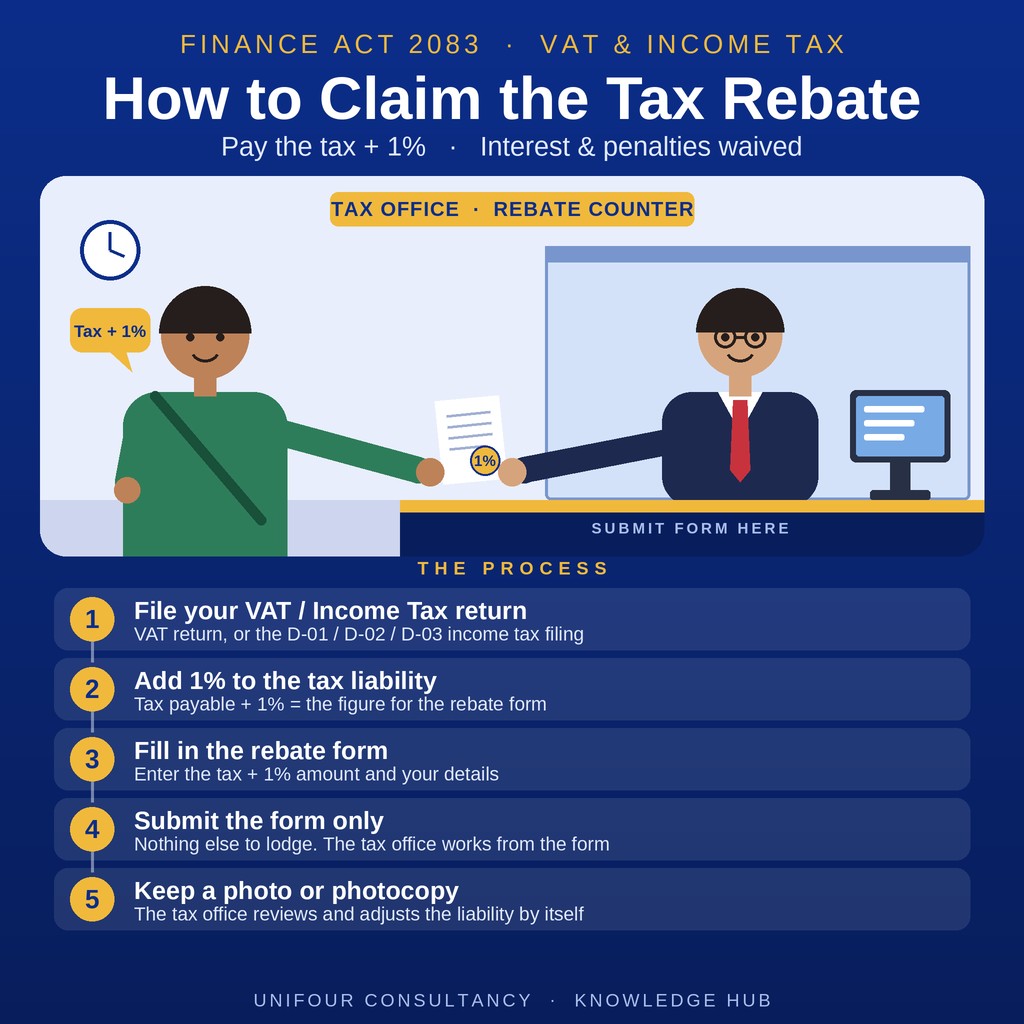
The mechanics are refreshingly simple. The important thing to understand is that the IRD acts on the form you submit — you do the filing, declare the correct figure with the 1%, submit the form, and the department does the rest at its end.
For VAT
- Do your VAT filing first. Prepare and file the VAT return(s) for the period you are regularising, exactly as you normally would on the IRD portal.
- Read the tax liability that the VAT filing produces — this is your actual VAT payable for that period.
- Add the 1%. Take the liability from the filing and add 1% on top. That total (tax + 1%) is what you settle under the scheme.
- Fill out the waiver / settlement form for the relevant provision with that figure.
- Submit the form — and only the form. You do not need to submit anything else. The IRD will act on the submitted form alone.
For income tax
- Complete your income tax filing — the D-01 / D-02 / D-03 steps on the IRD portal (return and the related payment vouchers), just as in a normal filing.
- Take the resulting tax liability, add the 1% where the provision requires it, and enter that in the waiver form.
- Submit the form. Again, the department only takes the submitted form — there is nothing extra to lodge alongside it.
After you submit
- Keep a copy. Take a photo of the submitted form, or make a photocopy — whatever is easiest — so you have your own record of what was lodged and when.
- Leave it with the department. There is nothing more to chase at that point.
- The IRD reviews and adjusts. After some time the department reviews your submission and adjusts the liability and the waiver on its side, finalising everything at the end. You simply wait for that reconciliation.
Deadlines at a glance
| Provision | Deadline |
|---|---|
| VAT (Sec. 41, 44, 45), most income tax (Sec. 40), excise (Sec. 43(1)), pending disputes (Sec. 46, 50) | End of Poush 2083 (~mid-January 2027) |
| Annual Finance Act dues (Sec. 49); UN/diplomatic staff (Sec. 47) | End of Mangsir 2083 (~mid-December 2026) |
| Company regularisation (Sec. 48); excise licence renewal (Sec. 43(2)) | End of Ashoj 2083 |
Deadlines differ by source and may be extended or clarified by IRD notice — always confirm the current date before you file.
What exactly gets waived
Across the VAT, income tax and excise provisions, settling under the scheme waives:
- Interest on the unpaid tax;
- Additional fees / charges;
- Late-filing fees;
- Penalties (fines) linked to the non-filing or non-payment.
What you still pay is the actual tax (principal) and, for most categories, the 1% add-on. Because interest and penalties on old dues often exceed the tax itself, the saving is usually substantial.
How Unifour can help
We handle the whole cycle for you: pulling the correct figures for each year, doing the VAT or income tax filing, calculating the tax + 1%, preparing and submitting the right waiver form, and keeping your copy on record. If you have a dispute pending, we will advise on whether withdrawing and settling is the right call before you commit.
The window is time-boxed and the savings on old dues can be large. If you think you have legacy VAT, income tax or excise exposure, reach out through our Contact section and we will review your position.